
Outdoor Trade Show Displays: Set Up Guide & Best Options (2026)
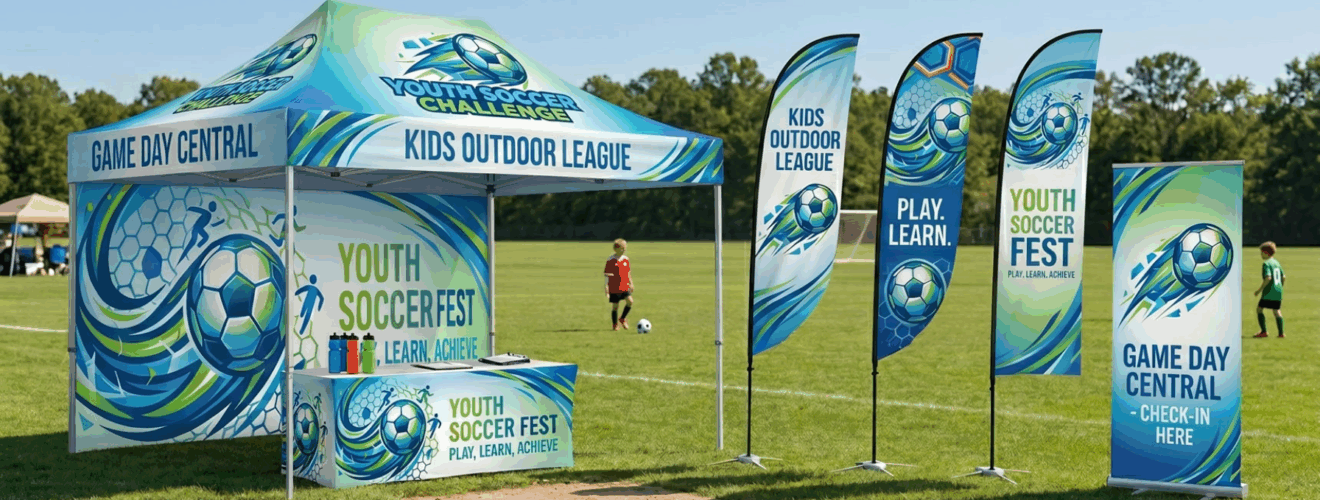
Outdoor trade show displays are portable, weather-resistant marketing structures — including pop-up tents, feather flags, outdoor banner stands, and event banners — designed to showcase your brand at open-air exhibitions, festivals, and street-level activations. Unlike indoor booth setups, outdoor displays must handle wind, rain, direct sunlight, and uneven terrain while still delivering a polished, professional look that draws foot traffic from a distance.
Whether you’re exhibiting at an outdoor industry expo, a community fair, or a sidewalk sale, choosing the right outdoor display setup determines how visible your booth is, how quickly you can get it assembled, and how well it holds up through an unpredictable event day. This guide walks through each type of outdoor trade show display, the materials that matter, and the weatherproofing strategies that separate a great outdoor booth from one that ends up chasing its signage across a parking lot.
What Makes Outdoor Displays Different from Indoor Trade Show Booths?
Indoor trade show booths operate in a controlled environment — flat carpet, consistent lighting, climate-controlled air, and security overnight. Outdoor trade show displays don’t get any of those advantages, and that changes what you need from every piece of your setup.
The three biggest differences come down to environmental exposure, visibility distance, and portability.
Environmental exposure is the most obvious factor. Wind loads, UV degradation, rain, and temperature swings all affect material choices. A fabric tension display that looks stunning inside a convention center can fade, sag, or blow over within hours of outdoor use if it wasn’t built for exterior conditions.
Visibility distance matters more outdoors because you’re not constrained to a 10-foot aisle. Attendees may first spot your booth from 100 feet away or more. This is why tall-profile displays like feather flags, pop-up tents with branded canopies, and elevated banners tend to outperform ground-level tabletop setups at outdoor events.
Portability requirements are more demanding for outdoor shows. You’re often setting up on grass, gravel, or asphalt with no access to electricity, loading docks, or storage. Every component needs to be easy to carry, fast to assemble, and self-sufficient.
Types of Outdoor Trade Show Displays
Each outdoor display type serves a different purpose within your booth layout. Most successful outdoor setups combine two or three types to create a branded zone that’s visible from a distance and functional up close.
 Pop-Up Tents and Canopies
Custom pop-up tents are the foundation of nearly every outdoor trade show booth. A branded 10×10 canopy provides shade, rain protection, and an instantly recognizable structure that anchors your entire setup. Larger 10×20 configurations work for exhibitors who need room for product demos or multiple meeting areas.
The best trade show tents use aluminum frames (lighter than steel, rust-resistant) with polyester canopies treated for UV resistance and water repellency. Look for tents with sidewalls — they add wind protection, create a more enclosed branded space, and give you additional surface area for graphics.
Setup time for most pop-up tent systems is 10–15 minutes with two people and no tools required. The frame telescopes out, the canopy stretches over the top, and weighted bases keep everything anchored.
 Feather Flags and Swooper Flags
Feather flags (also called swooper flags or bow flags) are tall, narrow flag banners that mount on flexible poles and catch wind to create movement. They’re one of the highest-visibility outdoor displays available because they stand 8–15 feet tall and their constant motion naturally draws the eye.
Use feather flags as perimeter markers around your booth space, along walkways to guide foot traffic, or flanking your tent entrance. They’re especially effective at outdoor events where you need to be seen from across a field or parking lot. Most feather flag kits include a ground spike for soft surfaces and a cross base with water ring for hard surfaces, so they work on grass or pavement.
 Outdoor Banner Stands
Outdoor banner stands are the weather-resistant cousins of the retractable banner stands you’d use indoors. They feature wider, weighted bases and wind-venting features that prevent them from acting like sails in a breeze. Some use spring-loaded tension systems that absorb gusts rather than toppling over.
Outdoor banner stands work well for placing branded messaging at your tent entrance, along a registration queue, or at the edge of your booth footprint. They’re compact enough to fit in a car trunk and set up in under two minutes per stand.
 Outdoor Hanging Banners
Vinyl hanging banners — available in mesh or solid scrim materials — are a cost-effective way to add large-format branding to your outdoor booth. Mesh banners are the better choice for windy locations because air passes through the material rather than pushing against it. Scrim vinyl banners deliver more vivid graphics and work well in calmer conditions.
Hang them across the back of your tent, between poles, or along fencing and barriers at the event venue. Standard sizes start at 3×6 feet, but custom dimensions are available for any configuration.
 Outdoor Portable Counters and Bars
Portable display counters designed for outdoor use give you a branded surface for product demos, lead capture, or sample distribution. The best options feature weather-resistant shells, internal storage, and wrap-around graphics that match the rest of your display setup.
They’re also increasingly popular for outdoor beverage activations and sampling events, where a branded bar counter creates a natural gathering point.
How to Choose Weather-Resistant Display Materials
Not all trade show display materials survive outdoor conditions. The difference between a display that lasts one event and one that lasts several seasons comes down to three material properties: UV resistance, water repellency, and wind tolerance.
UV Resistance
Direct sunlight breaks down dyes and weakens fabrics over time. For outdoor displays, prioritize materials with UV-inhibitor coatings or dye-sublimation printing (where the ink bonds into the fabric rather than sitting on the surface). Dye-sublimated polyester graphics resist fading significantly longer than digitally printed vinyl in direct sun exposure.
Water Repellency
Waterproof is better than water-resistant for outdoor displays. Polyester tent canopies should have a waterproof coating rated at 600 denier or higher. Vinyl banners are naturally water-resistant, but check that grommets are rust-proof (brass or stainless steel, not uncoated metal).
Wind Tolerance
This is where many exhibitors underestimate outdoor conditions. A standard indoor retractable banner stand can topple in winds as low as 10 mph. Outdoor-rated displays address wind through three strategies: weighted bases (water-filled rings, sandbags, or cross bases with ballast), vented materials (mesh banners, perforated fabrics), and flexible structures (feather flags on fiberglass poles that bend rather than break).
Setup Tips for Outdoor Trade Show Events
Getting your outdoor display set up efficiently — and keeping it standing all day — requires a different approach than indoor booth assembly. Here are the practices that experienced outdoor exhibitors rely on.
Arrive Early and Scout Your Space
Outdoor booth spaces aren’t always as level or uniform as the floor plan suggests. Arrive early enough to walk your assigned footprint and check for slopes, sprinkler heads, soft patches, or drainage paths. Adjust your tent placement so water flows away from your booth, not through it.
Anchor Everything — Then Anchor It Again
The number-one mistake at outdoor trade shows is insufficient anchoring. Even on a calm morning, afternoon gusts can develop quickly. Use all available anchoring options for your tent: water ring weights on hard surfaces, auger stakes on grass or dirt, and guy ropes for additional wind stability. For banner stands and feather flags, always use the weighted base accessories — never rely on the pole alone.
Plan for Power Independence
Many outdoor booth locations don’t offer electrical hookups. If you need power for lighting, monitors, or device charging, bring a portable battery station or a quiet generator. LED display lights draw minimal power and can run all day on a single battery pack. Avoid planning a setup that depends on power you haven’t confirmed with the event organizer.
Create Shade and Shelter Strategically
Your tent canopy protects your products and staff, but also think about shade from your attendees’ perspective. Position your tent so the shaded area extends toward the main foot traffic path — people are more likely to stop at a booth where they can step out of the sun. If your budget allows, add sidewalls on the sun-facing sides and leave the approach side open.
Pack a Weather Kit
Even if the forecast looks clear, pack supplies for weather contingencies: zip ties for emergency structural repairs, extra sandbags or water weights, a roll of gaffer tape, towels for drying surfaces after a rain shower, and clear plastic sheeting to cover sensitive products or electronics quickly.
Outdoor Display Accessories You Shouldn’t Skip
Beyond the primary display structures, a few accessories make a significant difference in how your outdoor booth performs.
Water ring weights and sandbags keep your tent and banner stands stable in wind. Water rings are convenient because you fill them on-site rather than transporting heavy weights.
Ground stakes and auger bases are essential for grass or dirt setups. An auger base screws into the ground and provides a secure anchor point for feather flags and tent legs.
LED clamp lights attach to tent poles and frame edges to keep your booth visible as natural light changes throughout the day. Battery-powered options eliminate the need for electrical access.
Custom-printed sidewalls turn your tent from a generic canopy into a fully branded enclosure, adding wind protection and display surface area at the same time.
Shop All Outdoor Display Accessories →
Frequently Asked Questions
What is the best outdoor trade show display for windy conditions?
Feather flags and mesh vinyl banners are the most wind-tolerant outdoor trade show displays. Feather flags use flexible fiberglass poles that bend with gusts rather than resisting them, while mesh banners allow air to pass through the material. For larger structures, a pop-up tent with water ring weights on all four legs and optional guy ropes provides the most stable anchored setup in moderate wind conditions.
How much do outdoor trade show displays cost?
Outdoor trade show display costs range from approximately $30 for basic accessories like water ring weights to $2,000+ for a fully branded custom pop-up tent package with sidewalls and carrying case. Feather flag kits typically fall between $100 and $300 each. Outdoor banner stands range from $150 to $500 depending on size and features. Most exhibitors invest between $500 and $3,000 for a complete outdoor booth setup.
Can I use indoor trade show displays outdoors?
Most indoor trade show displays are not designed for outdoor use. Standard retractable banner stands lack the weighted bases needed for wind stability. Fabric tension displays may fade quickly in direct sunlight if the graphics aren’t UV-treated. If you need to use some indoor displays at an outdoor event, place them under a tent canopy for protection and add supplemental weights, but plan to replace graphics more frequently due to accelerated wear.
How do I secure an outdoor trade show tent on asphalt or concrete?
On hard surfaces where ground stakes aren’t an option, use water ring weights (also called water bags) on each tent leg. These typically hold 5–10 gallons of water per ring, providing 40–80 pounds of ballast per leg. Cross-base weighted plates and sandbags are also effective. For high-wind locations, combine multiple anchoring methods and consider using guy ropes attached to nearby fixed structures or vehicle tow points.
What size pop-up tent is best for trade shows?
A 10×10-foot pop-up tent is the most common size for outdoor trade shows and fits a standard single booth space. It provides enough room for a display counter, two staff members, and a small product display. For larger setups or exhibitors who need a demo area, a 10×20-foot tent offers double the coverage. Some events allow 20×20 configurations for premium exhibitors.
APG Exhibits has been helping businesses stand out at trade shows for over 50 years. Browse our full collection of outdoor trade show displays to find the right setup for your next outdoor event, or contact our team for personalized recommendations.


