
Feather Flags vs. Banner Stands: Which Outdoor Display Wins?
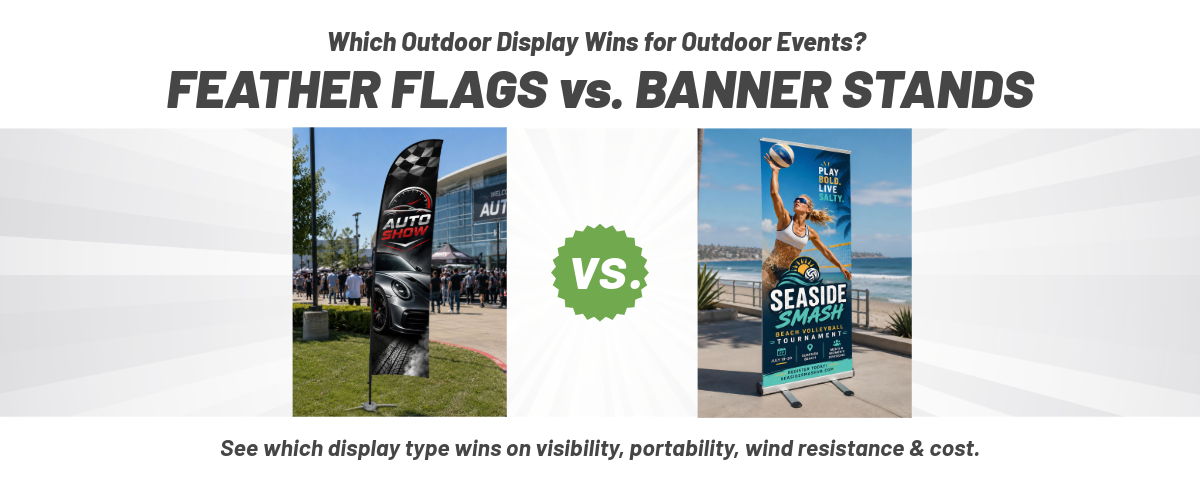
Feather flags and banner stands are the two most popular portable display options for outdoor events, but they solve different problems. Feather flags are tall, wind-driven flag banners designed to attract attention from a distance, while banner stands are compact, retractable or fixed-frame displays that deliver detailed messaging at close range. Choosing the right one — or combining both — depends on your event layout, wind conditions, and what you need attendees to do when they see your display.
This guide breaks down how feather flags and banner stands compare across every factor that matters at outdoor trade shows, festivals, and street-level events: visibility, portability, wind performance, print area, setup time, and cost.
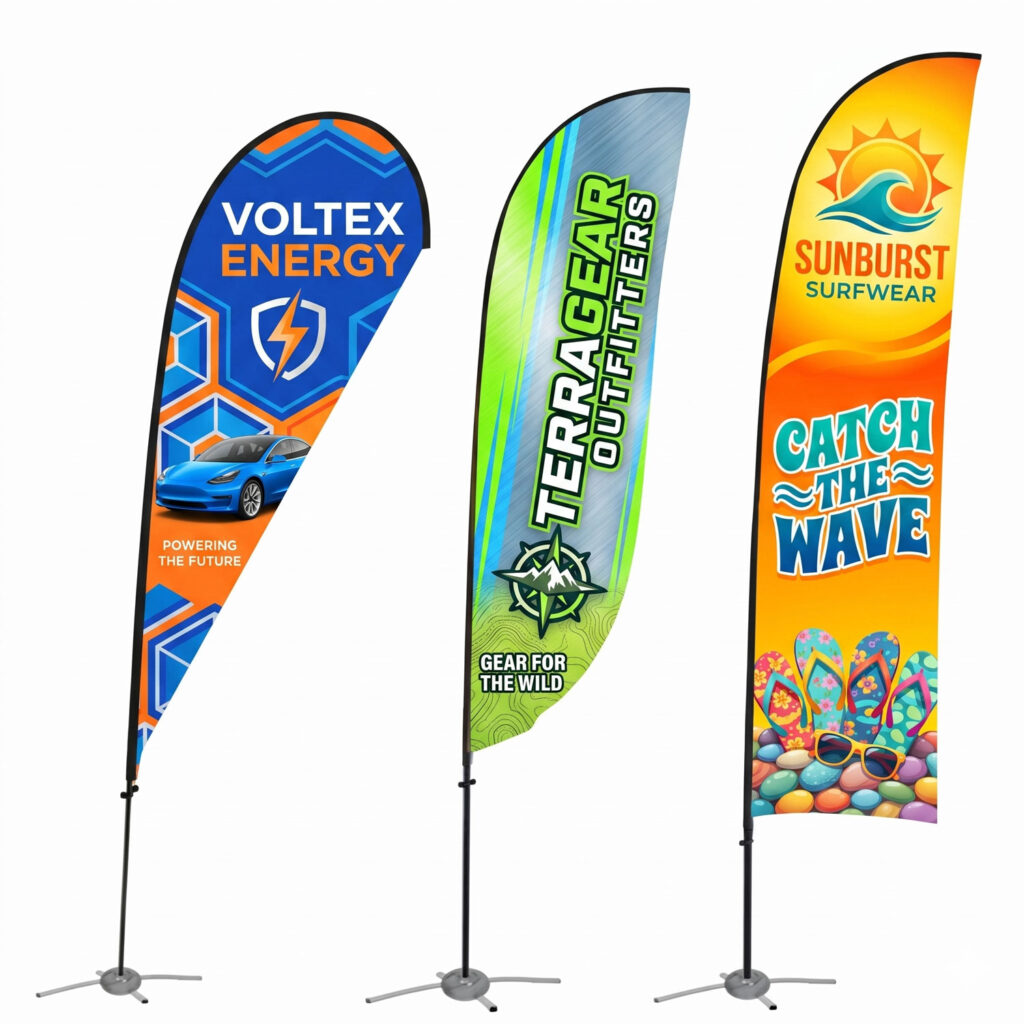
Zoom Flex Large Outdoor Flags
What Are Feather Flags?
Feather flags (also called swooper flags, flutter flags, or bow flags) are tall, narrow advertising flags that mount on a flexible fiberglass or aluminum pole. They typically stand between 8 and 15 feet tall and feature a single-sided or double-sided printed fabric panel shaped like a feather or teardrop. The flexible pole allows the flag to bend and sway in wind, which creates constant motion that naturally catches the eye.
Feather flags are anchored using either a ground spike (for grass and soft surfaces), a cross base with water ring weight (for pavement and hard surfaces), or a tire base (for parking lot setups). They’re widely used at outdoor trade shows, auto dealerships, grand openings, sporting events, and anywhere a business needs tall, visible signage without a permanent installation.
Browse Feather Flags at APG Exhibits →
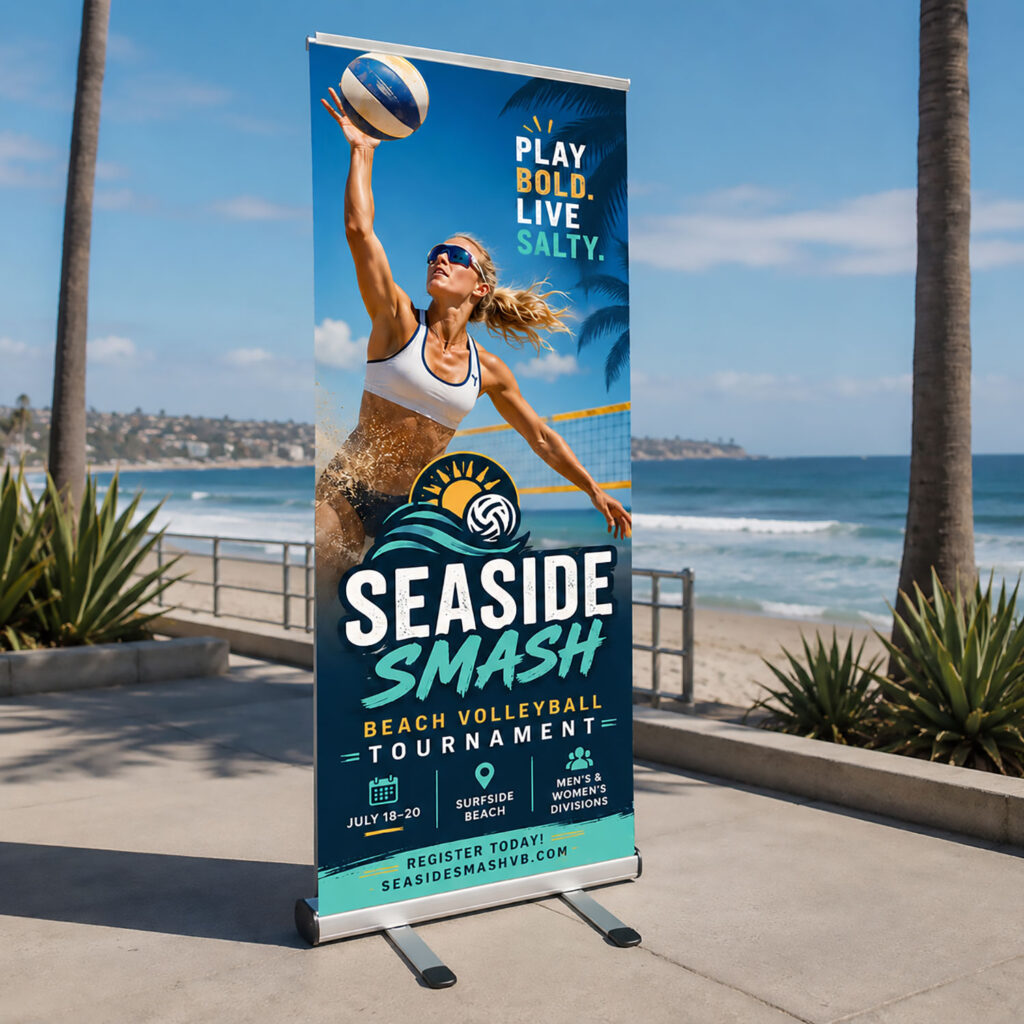
Thunder Double-Sided Outdoor Banner Stand
What Are Banner Stands?
Banner stands are freestanding display systems that hold a printed graphic panel on a rigid or semi-rigid frame. The most common type is the retractable banner stand (also called a roll-up banner or pull-up banner), where the printed graphic rolls into a compact base and extends upward on a telescoping pole. Standard retractable banner stands are typically 33 inches wide by 78–85 inches tall.
For outdoor use, specialized outdoor banner stands feature wider bases, heavier construction, and wind-venting or spring-loaded mechanisms that absorb gusts. Unlike feather flags, banner stands present a flat, stable surface — which means they can display detailed text, product images, pricing, and QR codes that attendees can read up close.
Browse Banner Stands at APG Exhibits →
Feather Flags vs. Banner Stands: Side-by-Side Comparison
| Feature | Feather Flags | Banner Stands |
|---|---|---|
| Height | 8–15 feet | 6–8 feet |
| Visibility Range | 100+ feet (high distance visibility) | 10–30 feet (close-range detail) |
| Wind Performance | Excellent — designed to move in wind | Moderate — outdoor models handle gusts; indoor models topple easily |
| Print Area | Narrow, curved — best for logos, short text, brand colors | Wide, flat — supports detailed messaging, images, QR codes |
| Setup Time | 2–5 minutes per flag | Under 2 minutes per stand |
| Portability | Lightweight pole + fabric in carry bag (5–10 lbs) | Self-contained unit in carry case (8–15 lbs) |
| Typical Cost | $100–$300 per flag kit | $150–$500 per stand |
| Best For | Perimeter marking, wayfinding, distance branding | Booth entrance messaging, product info, close-range engagement |
| Durability Outdoors | High — fiberglass poles flex, fabric is UV-treated | Moderate to High — depends on indoor vs. outdoor-rated model |
| Double-Sided Printing | Available (at added cost) | Most are single-sided; double-sided options exist |
When to Use Feather Flags at Outdoor Events
Feather flags excel in situations where your primary goal is getting noticed from a distance. Their height and constant movement give them an attention-grabbing quality that static displays simply can’t match. Here are the scenarios where feather flags are the stronger choice.
Perimeter and wayfinding. Line feather flags along the edges of your booth space or along walkways leading to your location. At large outdoor events, attendees navigating a sprawling field of vendors will spot your flags before they can read any banner stand from that distance.
Open-air events with wide sightlines. Outdoor festivals, farmers markets, auto shows, and trade shows held in parking lots or fairgrounds give feather flags room to work. Their 8–15 foot height makes them visible over tents, crowds, and other booth structures.
Windy conditions. This is the feather flag’s biggest advantage over banner stands. While a standard retractable banner stand can topple in winds as low as 10 mph, feather flags are built to perform in wind. Their fiberglass poles bend rather than resist, and the fabric panel functions like a sail that stays oriented into the breeze. In moderate to heavy wind, feather flags actually look better — the movement becomes more dramatic and eye-catching.
Simple brand messaging. If your goal is logo visibility and brand recognition rather than communicating detailed information, feather flags deliver more impact per dollar. A bold logo and one or two words (“OPEN,” “SALE,” or your company name) read clearly from far away on the narrow flag format.
When Banner Stands Are the Better Choice
Banner stands win when you need attendees to stop, read, and engage with your messaging. Their flat, wide graphic surface supports the kind of detailed content that gets lost on a feather flag’s narrow, curved shape.
Booth entrance and welcome displays. Position a retractable banner stand at your tent entrance to communicate your value proposition, product lineup, or event-specific promotion. This is where people transition from walking past to walking in — and a clear, detailed message makes that conversion happen.
Product information and pricing. If you’re displaying specific products, services, or pricing at an outdoor event, banner stands give you the space to include product photos, feature lists, pricing tiers, and contact details. Try fitting all of that on a feather flag — it doesn’t work.
QR codes and calls to action. Banner stands sit at eye level and remain stationary, which makes them ideal for QR codes, URLs, and other scannable elements. A QR code on a fluttering feather flag is nearly impossible to scan.
Indoor-outdoor hybrid events. Many trade shows have both indoor exhibit halls and outdoor demo areas. Retractable banner stands transition seamlessly between the two settings because they don’t need ground stakes or heavy bases when used indoors. A feather flag indoors with a cross base takes up too much floor space and looks out of place.
Calm weather conditions. On still days, feather flags droop and lose their visual impact. Banner stands look exactly the same regardless of wind — their rigid frame keeps the graphic taut and readable whether it’s dead calm or lightly breezy.
Can You Use Both? (Yes — and You Should)
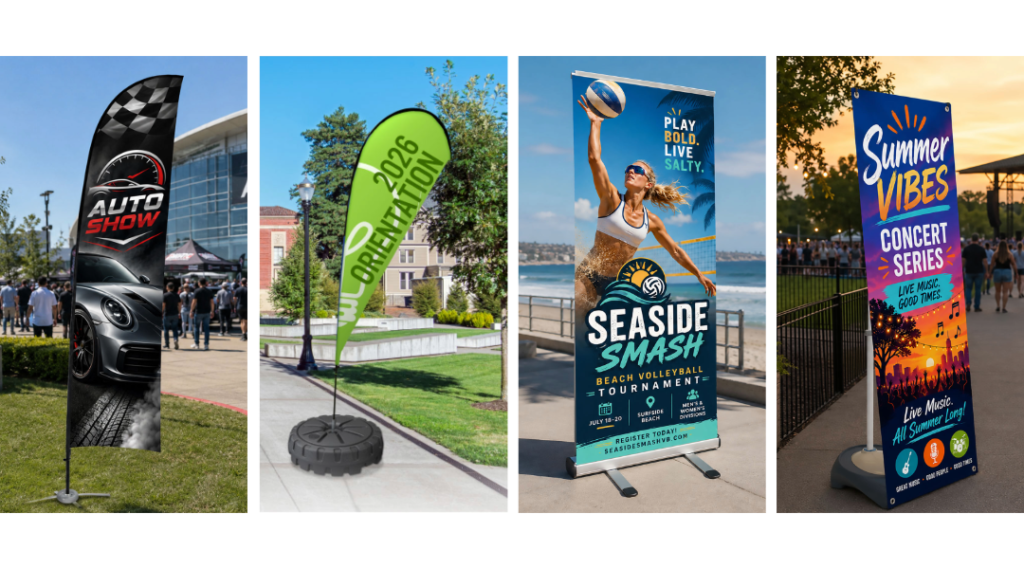
The most effective outdoor trade show booths don’t choose between feather flags and banner stands — they use both, assigning each display type to the job it does best.
A proven layout for outdoor events is to place two or three feather flags around the perimeter of your booth space (or along the walkway leading to your tent) for distance attraction, then position one or two banner stands at your tent entrance and inside your booth for close-range engagement. The feather flags pull foot traffic toward you from across the event. The banner stands close the deal once those attendees arrive.
This combination also gives you redundancy in unpredictable weather. If the wind picks up, your feather flags keep working while you secure lightweight items. If it’s dead calm, your banner stands carry the visual load while the feather flags hang quietly.
For a complete outdoor display setup that includes both, explore APG Exhibits’ full collection of outdoor trade show displays.
How to Choose Between Indoor and Outdoor Banner Stands
If you decide banner stands are right for your event, make sure you’re choosing the right category. Standard indoor retractable banner stands are not designed for outdoor use — and using one outside is the fastest way to damage your display and your brand image.
Indoor (retractable) banner stands are lightweight, affordable, and perfect for convention centers, lobbies, and trade show floors. They use a spring-loaded roller mechanism that stores the graphic inside a slim aluminum base. They’re not wind-rated.
Outdoor banner stands use wider bases, heavier-gauge materials, and wind-management features like vented graphics, spring-loaded tension arms, or weighted cross bases. They cost more than indoor models but won’t blow over in a gust or have their graphics shredded by wind stress.
APG Exhibits carries both categories: retractable banner stands for indoor use and outdoor-rated banner stands built for weather exposure.
Design Tips for Each Display Type
Feather Flag Design Best Practices
The narrow, vertical format of a feather flag demands a different design approach than a wide banner. Keep your layout simple: one dominant graphic element (your logo or a hero product image) and no more than three words of text. Use high-contrast colors — your design needs to read from 100+ feet away against shifting outdoor backgrounds. Avoid fine details, small fonts, and horizontal text that fights the vertical format. Remember that the bottom third of the flag may be obscured by the pole sleeve, so keep your key content in the upper two-thirds.
Banner Stand Design Best Practices
Banner stands give you a 33-inch-wide by 78-inch-tall canvas — use it strategically from top to bottom. Place your logo and headline in the top third (eye level when standing), your key content and imagery in the middle third, and your call to action, contact info, or QR code in the bottom third. You have room for more detail than a feather flag, but don’t fill every inch — white space helps your message breathe and improves readability. Use fonts no smaller than 24 point for body text so your message is legible from 5–10 feet away.
Frequently Asked Questions
Are feather flags or banner stands better for windy outdoor events?
Feather flags perform better in wind than banner stands. Their flexible fiberglass poles and fabric panels are specifically designed to catch and move with the breeze, which actually increases their visual impact. Standard retractable banner stands can topple in winds above 10 mph. If your event will have wind, choose feather flags for outdoor positions and reserve banner stands for sheltered areas under tents or canopies.
How long do feather flags last outdoors?
A well-made feather flag used at periodic outdoor events typically lasts one to two seasons before the graphics show noticeable fading. Flags used in permanent outdoor installations (like car dealerships) may need replacement every 3–6 months depending on sun exposure. UV-treated polyester fabric and dye-sublimation printing extend lifespan significantly compared to digitally printed alternatives.
Can I use a retractable banner stand outdoors?
Standard retractable banner stands are designed for indoor use and should not be used outdoors without protection. Wind can topple them, rain can damage the spring mechanism, and UV exposure fades the graphics quickly. If you need a banner stand for outdoor use, choose a model specifically rated for outdoor conditions — these feature weighted bases, wind-venting graphics, and weather-resistant construction.
What size feather flag is best for trade shows?
A 12-foot feather flag is the most versatile size for outdoor trade shows. It’s tall enough to be visible over tent canopies and crowds (most event tents peak at 10–11 feet) but not so large that it becomes difficult to transport or anchor. For smaller events, tabletop shows, or indoor use, 8-foot feather flags work well. For maximum distance visibility at large outdoor venues, consider 15-foot flags.
How many feather flags do I need for a trade show booth?
Two to four feather flags is the typical range for a standard 10×10 booth space at an outdoor event. Two flags flanking your tent entrance create a branded gateway effect. Four flags — one at each corner of your booth footprint — establish a clear branded perimeter that’s visible from all approach directions. For larger booth spaces (10×20 or 20×20), scale up to four to six flags.
APG Exhibits carries a full selection of feather flags, banner stands, and outdoor trade show displays to help you build the right setup for any event. Need help deciding? Contact our team for a personalized recommendation.


